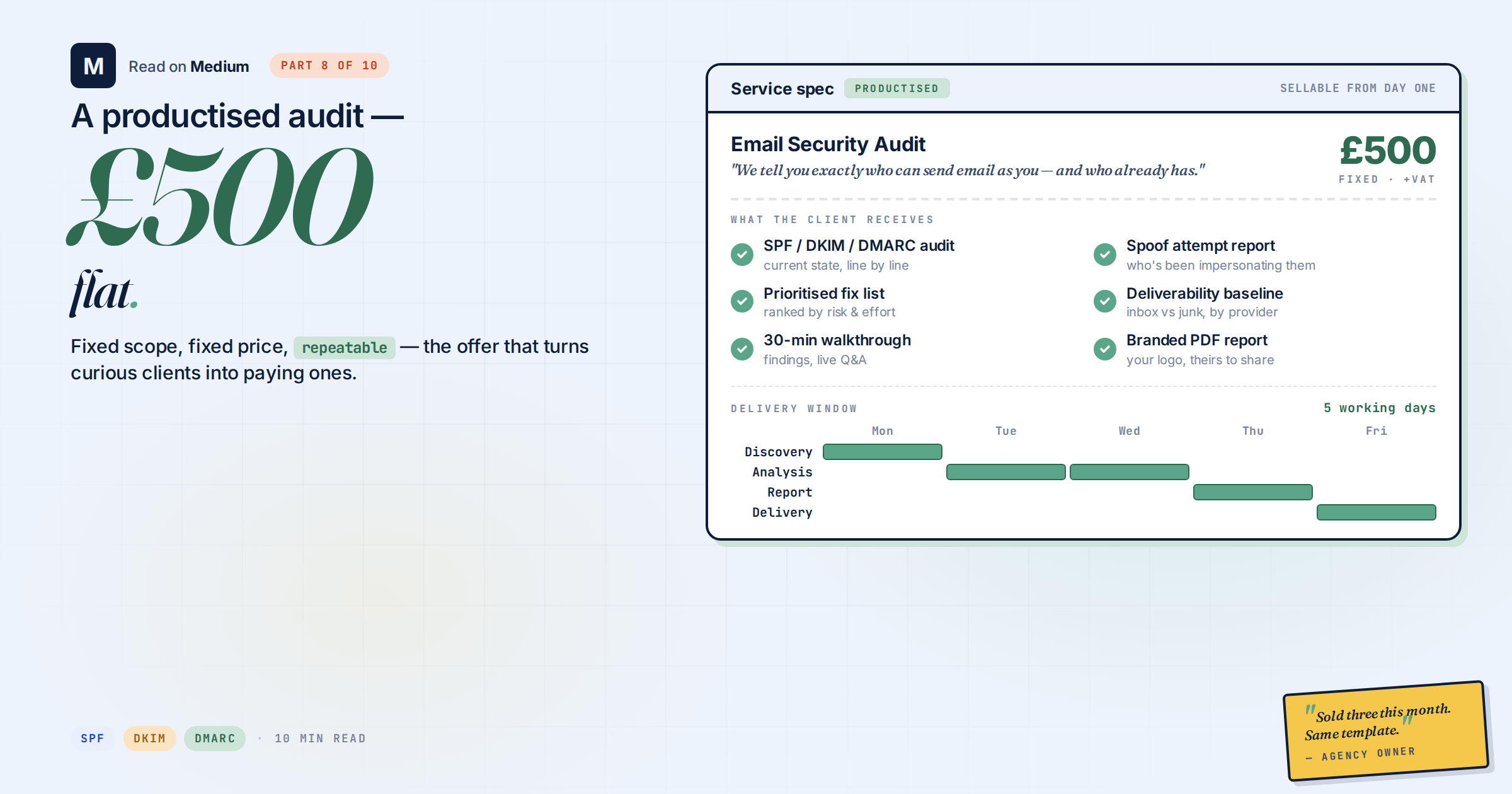
This is a productised service that any web or digital agency can start selling this week. It generates £500-1,500 per engagement, takes about 3-4 hours of actual work, and has an extremely high conversion rate from the first conversation because the value is obvious and the price is low. It also leads directly into a £50-150/month recurring monitoring service, which is where the real margin is.
I've seen versions of this offer run successfully by agencies with as few as two staff and as many as forty. The economics scale; the conversation doesn't change.
The offer
"Email Security Baseline Audit"
— a one-off engagement to audit and harden a client's email authentication configuration.
Deliverables:
- Current state assessment with letter grades (DMARC, SPF, DKIM, MTA-STS, BIMI)
- Identified issues prioritised by business risk
- Remediation plan with specific DNS changes to make
- Implementation of agreed changes (typically 48 hours)
- One-month post-implementation verification
- Written executive summary for the client's leadership
Pricing:
- Small business (1-3 domains): £500
- Mid-sized (4-10 domains): £1,000
- Enterprise or complex (10+ domains, multiple ESPs): £1,500-3,000
Follow-on: continuous DMARC monitoring at £30-100/domain/month on a 12-month minimum.
Why it's an easy sell
Four things make this offer convert dramatically better than most professional services:
-
Concrete starting artefact. You walk into the conversation with the client's actual grade (from a free audit tool) in hand. You're not selling a discovery exercise — you're showing them the problem already exists and telling them what it costs to fix.
-
Fixed scope. Email authentication is a finite domain. Unlike "optimise your website" or "improve your marketing," DMARC has a specific correct state. You can credibly promise a specific outcome.
-
Low price point. £500 doesn't require committee approval at any company large enough to have an IT budget. It's in the "just expense it" band. Decisions get made in one meeting.
-
Recurring upsell. Every one-off audit converts into monitoring revenue if you position it right. The audit fixes the current state; monitoring keeps it fixed. Nobody wants to buy the same audit again next year because their DMARC has silently drifted.
The delivery process
Timing: 2-3 weeks from signed engagement to completed delivery, about 3-4 hours of your own active time.
Week 1, Day 1: Audit
Run the free audit at dmarcsentinel.com on every client domain they've asked you to assess. Save the shareable URLs for each. Screenshot the summary.
Also run:
dig queries to verify the raw records- An MX lookup to identify their email provider
- A reverse check on any unusual SPF
include: entries to figure out what legacy services might still be in play
Total time: 15 minutes for a single domain, up to an hour for 10 domains.
Week 1, Day 2-3: Analysis and plan
Review the audit output and produce a remediation plan. For each finding:
- Business impact in plain English (not technical jargon)
- Specific DNS change required
- Risk of making the change (almost always "very low" but occasionally "requires coordinating with M365 admin")
- Expected outcome
Put this in a short document (5-10 pages). The audit's PDF export gives you the technical meat; you add the business-framed executive summary and the implementation plan.
Total time: 1-2 hours per domain.
Week 2: Implementation
Coordinate the DNS changes with whoever controls the client's DNS. For 90% of clients this is the agency themselves (you already manage their hosting and DNS) or an IT-in-a-box provider who can make changes quickly.
Order of operations for the typical F-grade starting point:
- Fix SPF lookup count issues (cull unused includes, consolidate)
- Configure domain-aligned DKIM at every ESP the client uses
- Publish DMARC record at
p=none with rua= pointing at a monitoring address
- Wait 7-14 days of aggregate report data to verify no legitimate mail is failing
- Tighten to
p=quarantine with pct=25, ramp to pct=100 over 2-3 weeks
- Final tightening to
p=reject
This staged rollout is the correct technical approach, but the offer is delivered in two phases: "immediate fixes" (steps 1-3, done in week 2) and "ongoing monitoring" (steps 4-6, which is the follow-on monthly engagement).
Total time: 1-2 hours per domain for the immediate fixes.
Week 3: Delivery and handover
Written executive summary delivered to the client, including:
- Starting grade vs ending grade
- Specific improvements made
- Outstanding items that will be resolved through the monitoring engagement
- Recommendations for their broader security posture (nudge toward MFA, password manager, basic stuff they probably also don't have)
At this meeting, propose the ongoing monitoring engagement. The natural language: "The work we've just done gets you to baseline compliance, but DMARC configuration drifts — ESPs change infrastructure, new senders get added, something breaks. We monitor and alert on changes, plus we complete the migration to p=reject over the next two months, for £X/month."
Total time: 1 hour for the handover meeting.
The proposal template
Keep it short. A one-page proposal converts better than a ten-page one.
Subject: Email security baseline — proposal
Current state. We ran an audit on [yourdomain.com] this morning. It's currently scoring [grade]. The specific issues are: [two or three sentences on the top issues]. In practice this means [business impact — one sentence].
What we'd do. Fix the configuration issues, get DMARC enforcement in place, and verify that no legitimate email is being affected by the changes. The work takes about two weeks start to finish with you unavailable for about an hour of that time.
Cost. £[X] one-off. Fixed price, no contingencies.
Afterwards. We recommend ongoing monitoring so the configuration doesn't drift — this catches issues within minutes instead of after a customer complaint. £[Y]/month, minimum 12 months, cancel any time.
Next step. Reply yes and I'll send an engagement letter. We can start next week.
Sign, send, move on.
Who to sell it to
Three concentric circles, in order of ease.
Inner circle: existing retainer clients
Any client currently on a monthly retainer with you for hosting, SEO, or general digital work. You already have their DNS access (probably), you already have their trust, you already have a billing relationship. This is a one-email sale.
"We've added an email security service to our offering. I ran the free audit against [yourdomain.com] this morning and it came back with some issues worth addressing — do you have 15 minutes next week to walk through it?"
Conversion rate from existing clients in the low-risk bucket: 40-60%. Some will say no because they just don't want to spend, but most will say yes because (a) you've already built the trust and (b) running the audit for them before they ask is a high-value free act.
Middle circle: lapsed clients and warm network
Former clients you've worked with before, business contacts who know your work, referrals from existing clients. The warm-intro version of the same pitch. Run the audit against their domain before you reach out, so your email contains concrete findings rather than a generic pitch.
Conversion rate: 10-20%. Lower because the relationship is older, but volume is higher because your network is larger than your active roster.
Outer circle: cold outbound
Identify agencies, businesses, or niches where email is clearly critical to their operation. Run the audit on their domain. If it's F-grade, write them a specific cold email:
"Ran a free DMARC audit on [yourdomain.com] — scored F. Main issue is [specific]. I help agencies fix this; happy to share the full report if useful."
Conversion rate on cold: 2-5%. Low but scalable. This is the one that lets you grow past your warm network once you've saturated it.
What the monitoring tier looks like
Once you're delivering these audits at volume, the monitoring tier becomes your recurring revenue backbone. The maths:
- 20 clients at £50/domain/month, average 3 domains each = £3,000 MRR from monitoring alone.
- Plus £500-1,500 per new audit you book.
- Plus whatever your existing retainer work looks like.
The monitoring service itself requires very little ongoing work from you if you're using a proper back-end. You're not reading DMARC reports by hand; the tool flags changes and you respond to alerts. Most clients will need 15 minutes of your attention per month on average, often less.
DMARC Sentinel's Agency tier — the product I'm building alongside the free audit — is designed specifically for this use case: multi-tenant dashboards, white-label client reports, API access for your own client portal integration. If you'd rather use a different monitoring back-end, that's fine too; the economics of the service offering work regardless of the tool underneath.
The free audit at dmarcsentinel.com is free forever, doesn't require signup, and is designed to be the artefact you walk into sales conversations with.
The one-line version
Run the free audit, screenshot the grade, send a one-page proposal, charge £500-1,500, upsell monitoring for recurring margin. Rinse and repeat.
Jon Morby has run email and DNS infrastructure since the early 1990s. He built DMARC Sentinel after watching too many agencies discover their clients' email was going to spam the hard way.